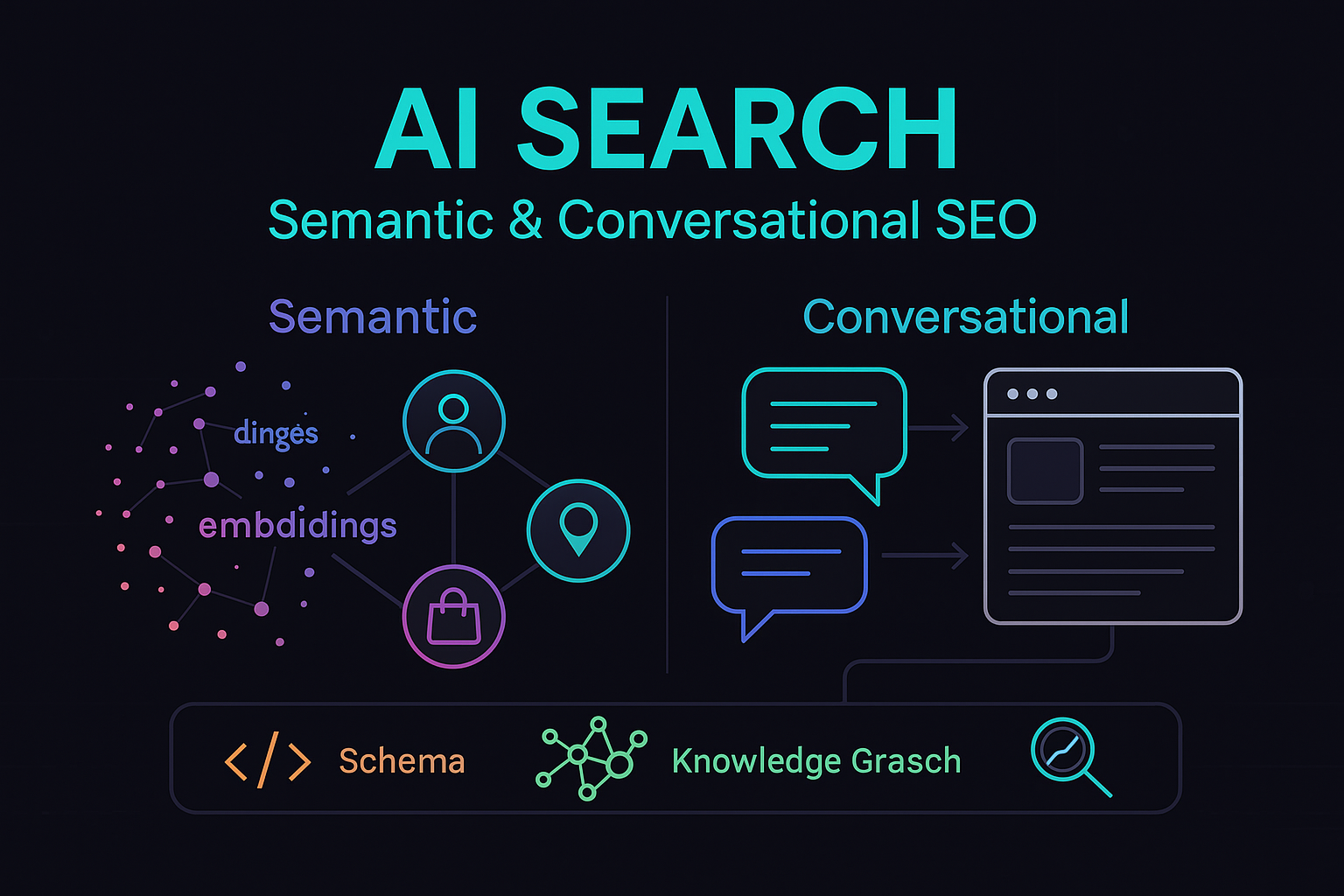
AI Search: Win with Semantic and Conversational SEO
AI for Search: Moving from Keywords to Semantic and Conversational Search
AI for search has shifted the game from literal keyword matching to semantic understanding and conversational intent. Instead of chasing exact phrases, modern search engines and assistants use natural language processing, embeddings, and knowledge graphs to interpret meaning, context, and entities. The result? Answers that map to a user’s goal rather than their exact words. For brands and publishers, this evolution demands entity-first content, structured data, and dialogue-friendly formats that serve zero-click answers, featured snippets, and AI overviews. This guide unpacks how to adapt your SEO and content strategy to semantic SEO, vector search, and multi-turn conversational search—so you capture discovery across traditional SERPs, answer engines, and AI assistants while building durable topical authority.
From Keywords to Meaning: Entities, Embeddings, and Intent
Classic SEO prioritized density and exact-match keywords. AI-led search prioritizes meaning. Large language models and vector databases encode words, phrases, and documents into embeddings that represent concepts and relationships. Instead of matching “best running shoes,” the system locates semantically similar content covering cushioning, pronation, surfaces, and budgets—matching user intent even when the query uses different terms. This is semantic retrieval, not string matching.
At the core are entities—people, places, products, and ideas recognized across a knowledge graph. When your content clarifies entities and their attributes (brand, model, use cases, pros/cons), it becomes more findable in AI systems that pivot on entity relationships. Pair this with clear intent categories—informational, transactional, navigational, and local—and you signal relevance beyond the literal query.
What does this mean tactically? Optimize for entity salience and intent fit. Use consistent naming, define relationships, and write with disambiguation in mind. You’re not just ranking for terms—you’re convincing AI that your page is the most coherent, authoritative representation of a topic in its graph.
Designing for Conversational and Multi‑Turn Search
Conversational search treats discovery like a dialogue. Users ask an open question, then refine: “What are good cameras for travel?” becomes “Under $800?” and “How about low light?” AI assistants carry context across turns. Content that anticipates these refinements wins—because it’s structured to answer now and guide next.
Author content with a conversational arc: start with a concise answer, expand with rationale, and offer decision branches (“If you shoot video, consider X; for ultralight gear, pick Y”). Encourage follow-ups with natural-language subheads and cues like “Next questions you might have.” This makes your page a better candidate for answer engines and AI overviews that stitch responses into dialogue.
To support multi-turn reasoning, include comparative matrices, constraints (budgets, specs, timelines), and real-world scenarios. For technical topics, leverage pattern-based explanations (problem → diagnosis → options → trade-offs). The goal is to help AI produce coherent, stepwise guidance from your content without losing nuance.
Entity‑First Architecture: Schema, Topic Clusters, and Internal Links
Semantic SEO scales when your site architecture mirrors the knowledge graph. Build topic clusters: a pillar page that defines the core concept and hub-and-spoke articles that cover subtopics, FAQs, methods, comparisons, and use cases. Internally link with descriptive anchor text to reinforce entity relationships and topical coverage—this improves both crawlability and vector-based understanding.
Use structured data in JSON-LD to declare entities and attributes explicitly. At minimum, implement Organization, WebSite with SearchAction, BreadcrumbList, Article/BlogPosting, Product/Offer/Review, FAQPage, and HowTo where relevant. Rich metadata supports knowledge panels, rich results, and AI overviews by making machine-readable facts unambiguous.
Want a practical checklist? Try:
- Define canonical entities (names, IDs, categories) and keep them consistent across pages.
- Map each cluster to search intents and user journeys, not just keywords.
- Use descriptive, stable URLs and breadcrumbs to show hierarchy.
- Add concise, source-backed summaries at the top of pillars to supply high-confidence facts for answer extraction.
Creating AI‑Ready Content: E‑E‑A‑T, Formats, and UX for Answers
AI systems favor content that’s helpful, verifiable, and scannable. Demonstrate E‑E‑A‑T (Experience, Expertise, Authoritativeness, Trustworthiness) with author bylines, credentials, first-hand examples, citations to reliable sources, and transparent update logs. Pair narrative depth with skimmable structure: clear H2/H3 hierarchy, definition boxes, bullet lists, and precise summaries that can be excerpted into snippets.
Format for answer extraction and conversational reuse:
- Lead with a 1–2 sentence definition or verdict; follow with evidence and nuance.
- Include Q&A sections mirroring People Also Ask patterns.
- Add comparison tables and pros/cons lists for decision support.
- Use consistent units, thresholds, and named criteria to enable structured reasoning.
Your formatting is not decoration—it’s a machine interface that lets LLMs ground answers in your content.
Don’t neglect UX signals that buttress semantic relevance: fast Core Web Vitals, accessible markup (alt text, ARIA where needed), mobile-friendly layouts, and clean navigation. High satisfaction metrics—engagement, low pogo-sticking, deep scroll—reinforce that your page actually fulfills intent, which sustains visibility across SERPs and AI surfaces.
Measuring What Matters: Semantic Analytics and Iteration
Traditional rank tracking misses AI surfaces and zero-click outcomes. Modern measurement blends query semantics, entity tracking, and feature visibility. Cluster queries by intent and topic using NLP, then evaluate coverage and gaps at the cluster level, not just keywords. Track impressions and clicks from rich results, Discover, and video/carousel placements to see how your content travels across modalities.
Adopt entity-level KPIs: monitor which entities you rank for, which earn snippets or citations in AI overviews, and where you lack authority compared to competitors. Use internal search logs and on-site behavioral paths to learn which follow-up questions users ask after landing—then weave those into your conversational arcs.
For deeper diagnostics, analyze server logs to understand crawl patterns across clusters, compare embedding-based similarity (are your spokes semantically distinct?), and run content audits for factual freshness and source support. Iteration cadence matters: set a quarterly cycle to refresh facts, expand decision branches, and improve structured data—semantic equity compounds over time.
Conclusion
AI has pushed search from strings to things, from keywords to meaningful conversations. Winning in this landscape means building an entity-first content architecture, writing in dialogue-friendly formats, and proving E‑E‑A‑T with crisp facts and credible sources. Design pages that deliver direct answers and guided next steps, mark them up with schema, and link clusters to mirror how knowledge is organized. Then, measure performance at the topic and entity level to refine coverage and clarity. The payoff is durable visibility across SERPs, AI overviews, and assistants—where intent, not just phrasing, determines success. Ready to evolve your SEO? Start by mapping entities, restructuring pillars and spokes, and rewriting intros to answer first, explain second.