AI Code Generation 2025: Ship Production App Scaffolds Fast
AI Code Generation in 2025: From Autocomplete to Full App Scaffolding
In 2025, AI code generation has leapt from clever autocomplete to project-aware app scaffolding that spins up repositories, CI/CD, tests, and cloud infrastructure in minutes. Instead of suggesting the next line, modern assistants coordinate multi-step plans, consult your internal knowledge base, and generate production-grade blueprints. This shift merges code synthesis with architecture, DevSecOps, and documentation, reshaping how teams design, build, and ship software. Curious what changed? Larger context windows, tool use, and agent orchestration let AI understand specifications, choose frameworks, and create consistent scaffolds that adhere to your standards. The result is faster delivery, fewer regressions, and a path to scale engineering quality. Here’s how teams are adopting the new generation of AI coding assistants—and what to watch out for.
The Leap Beyond Autocomplete: From Snippets to Orchestrated Scaffolds
Yesterday’s AI coding assistants focused on token-by-token prediction. Today’s tools plan across files and steps, calling linters, test runners, and code formatters, and then applying AST-level edits rather than brittle string insertions. This planning ability means they can create new modules, wire dependencies, and refactor across the codebase while preserving style and patterns. The practical effect? Fewer broken imports, fewer merge conflicts, and code that feels “native” to your repository.
Scaffolding is now an orchestration problem. Assistants interpret a spec, select a stack, set up configs, and generate a working baseline. They don’t just write controllers; they generate project structure, environment files, seed data, and integration stubs. With multi-agent workflows, one agent designs APIs, another writes tests, and another configures pipelines—coordinated by a plan that you can inspect and approve. This transparency is crucial for trust and maintainability.
What about nuance and edge cases? Modern systems negotiate trade-offs explicitly: performance vs. readability, latency vs. cost, framework conventions vs. custom rules. By exposing these choices in readable plans and pull requests, AI becomes a pair architect, not a black box.
Architecture & Infrastructure: Blueprints That Ship
Scaffolding is no longer limited to application code. In 2025, AI assistants generate architecture-aligned blueprints that include infrastructure-as-code, observability, and deployment workflows. Given a high-level spec—say, a multi-tenant API with rate limiting—the assistant can propose architecture diagrams, pick a service topology, and instantiate templates for containerization, secrets, and telemetry. The output goes beyond boilerplate, embedding your organization’s baselines for security and reliability.
Expect assistants to create complete foundations, such as:
- Repository layouts with domain-driven modules, monorepo workspaces, and shared libraries.
- IaC (e.g., Terraform/Pulumi) for networks, databases, queues, and identity policies.
- CI/CD pipelines for build, test, lint, SAST/DAST, SBOM, and progressive deployment gates.
- Runtime configs for container images, feature flags, secrets management, and autoscaling.
Why does this matter? Architecture decisions are now codified and reproducible. The assistant captures organization-wide standards—naming, tagging, cost controls, and telemetry—and applies them consistently. You get composable scaffolds that scale from a prototype to regulated production, with fewer “drift” issues and less manual rework.
Quality, Security, and Compliance: Guardrails by Default
The critical shift in 2025 is that quality and security are built in, not tacked on. Assistants propose tests first, generate fixtures, and integrate coverage thresholds into pipelines. They run static analysis, secret scanning, and dependency audits while coding, flagging issues before they hit main. Instead of hoping the code is safe, you get policy-driven generation that aligns with your compliance model.
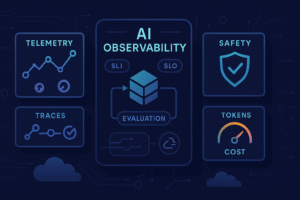
Teams embed policy-as-code to enforce standards: approved licenses, cryptography rules, data residency, and access patterns. The assistant checks every PR against those policies, updates the SBOM, and annotates risk. It also scaffolds observability—structured logs, traces, metrics—so that you can trace failures back to code and configuration. This closes the loop between development and operations and accelerates incident response.
Concerned about hallucinations? Guardrails include deterministic templates, reference links to spec sources, and executable validations (like contract tests from OpenAPI). If the generated code diverges from the spec, the pipeline fails early, keeping false positives low and trust high.
Context Is King: Code Graphs, RAG, and Private Knowledge
The quality of AI output hinges on context. Leading teams maintain a developer knowledge graph that links symbols, services, schemas, ADRs, design tokens, and runbooks. Assistants query this graph with retrieval-augmented generation (RAG), pulling the exact private patterns and APIs your org depends on. Instead of generic examples, you get code that matches your SDKs, conventions, and performance constraints.
Under the hood, semantic indexes and embeddings map functions to responsibilities, tests to behaviors, and configs to environments. This enables cross-repo refactors, accurate impact analysis, and consistent interface usage. The assistant knows that “Customer” in billing is not the same as “Customer” in CRM because the graph captures ownership, boundaries, and dependencies.
Privacy matters. Mature setups keep sensitive code on-prem or in a virtual private cloud, log prompts as artifacts, and apply data minimization so only the necessary context is retrieved. With short-lived tokens, redaction, and audit trails, teams benefit from rich context without leaking IP or secrets.
Human Workflows and Adoption: Pairing, PR Bots, and Measurable Outcomes
Even with powerful scaffolding, humans remain the decision-makers. The most effective pattern is human-in-the-loop pairing: the assistant proposes a plan, you edit the plan, then it implements. Pull-request bots attach rationales, risk notes, and test summaries. Reviewers focus on intent and boundary conditions rather than formatting or repetitive patterns. The result is faster, higher-confidence merges.
Adoption is a change-management problem as much as a tooling one. Successful teams standardize prompts, templates, and coding guidelines, then run short enablement sprints to socialize best practices. They also define explicit “no-go” areas—safety-critical kernels, novel algorithms—where manual design remains primary.
Measure impact with leading and lagging metrics:
- Lead time from idea to first PR and from PR to production.
- Change failure rate and mean time to restore (MTTR) post-incident.
- Test coverage, flaky test reduction, and defect density.
- Onboarding time for new contributors and time-to-first-merge.
When the assistant is embedded in planning, coding, and review, these metrics trend in the right direction—without sacrificing maintainability.
Conclusion
AI code generation in 2025 is about systematizing excellence. We’ve moved from line-level completion to full-stack scaffolding that encodes architecture, security, and operations from day one. The winning approach pairs multi-agent planning with strong guardrails, a rich private knowledge base, and human oversight. Start by curating templates and policies, index your code and docs, and pilot workflows where scaffolding yields clear wins—new services, internal tools, or integration adapters. Measure outcomes, refine prompts and policies, and scale gradually. With the right foundations, AI assistants don’t just write code; they help teams ship reliable, compliant, and observable software at a pace that was hard to imagine just a few years ago.
Will AI replace developers, or make them faster?
AI won’t replace developers; it amplifies them. Assistants handle scaffolding, repetitive glue code, and refactors, while humans own problem framing, trade-offs, and verification. The best outcomes come from pairing: humans set intent and review; AI executes predictable steps quickly.
How should a team start adopting AI scaffolding safely?
Begin with a curated template repository, policy-as-code, and a semantic index of your codebase. Pilot on low-risk services, require plan reviews, and wire guardrails into CI/CD. Add observability and contract tests so validations are automatic and reproducible.
What metrics demonstrate real ROI?
Track lead time to first PR, PR-to-prod, change failure rate, MTTR, and onboarding time. Supplement with coverage, defect density, and rework rates. If quality and velocity improve together, your adoption is healthy.
What risks should we watch for?
Common pitfalls include vendor lock-in, context leakage, unvetted dependencies, and silent drift from standards. Mitigate with portable templates, private retrieval, license and SBOM checks, and policy gates that fail builds on violations.